In the two newest conversions to be announced, office buildings in the Seaport and Financial District will be renovated into residential units. The Boston Business Journal calculates that they bring the total of Mayor Wu’s Office-to-Residential Conversion Program’s structures to 29.
Here is information on the newest two structures that will add to housing units for Boston’s growing population.
11 Avenue de Lafayette
Thibeault Development will renovate the mostly empty office building at 11 Avenue de Lafayette into apartments.
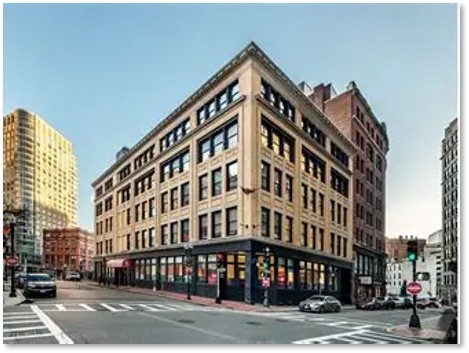
11 Avenue de Lafayette: Photo courtesy of LoopNet
The interior renovation will create approximately 70 rental apartment units on Levels one through five. According to the Boston Planning Department Most of the units will be studios, with ten one-bedroom units and five two-bedroom units. The plan calls for 12 of the apartments to be rented to people making no more than 60% of the Boston area median income.
Existing ground-floor retail businesses that face Essex Street will be preserved and remain in operation.
Avenue de Lafayette and Boston History
Number 11 sits on a rough triangle bordered by Avenue de Lafayette, Chauncy Street and Essex Street with a small segment on Kingston Street. This a desirable location right between the Financial District and Chinatown neighborhoods and it includes what is right now a gated parking lot.
The five-story, 58,000-square-foot property is currently empty, which gives Thibeault Development a clean slate for converting the office floors. The conversion will not affect the building’s footprint, height or massing in the city.
The Street’s Name
The street is named, of course, for the Marquis de Lafayette, a Frenchman who contributed significantly to the success of the American Revolution and who was much beloved in post-revolution Boston.
The Avenue de Lafayette is also only a short walk west from LaGrange Street, which was named after the Chateau de la Grange Bléneau, the country residence of the Marquis de Lafayette and his family southeast of Paris.
The Building
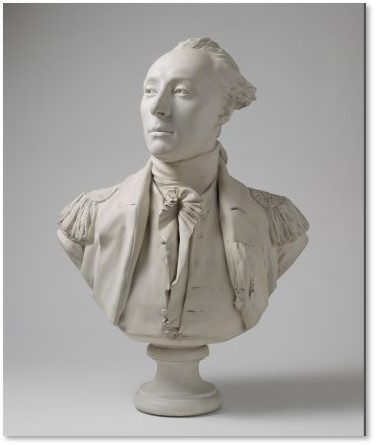
Marquis de Lafayette by Jean-Antoine Houdon, Boston Athenaeum
Constructed in 1899, the building is designed in the Victorian commercial style typical of the late 19th‑ and early 20th‑century office buildings erected in Boston’s financial district. The design reflects the ornate yet functional aesthetic of late Victorian and early Beaux‑Arts office buildings, combining decorative craftsmanship with practicality. Its brick-and- beam construction and cast‑iron architectural elements are characteristic of the period.
The design features exposed woodwork, masonry detailing, and large windows. Those windows face the Kingston Street Substation to the east (not the most scenic view) and the Hyatt Regency Hotel to the north. The nearby Theater District and a dizzying array of Chinatown restaurants offering a wide variety of cuisines make it well located for those who don’t like to cook. Take-out options boggle the mind.
320 Summer Street at A Street
A property in the Fort Point District will also join the ranks of commercial to residential buildings. A local developer, Fan Du, plans to create 145 apartments along with ground-floor retail space at 320 Summer Street.
Currently two neighboring office buildings occupy the block between A Street and the poetically named West Service Road. One is four stories and the other is slightly higher with five stories. Both have dentilled cornices that are slightly offset. They fill up the available space and will both be included in the conversion.
The Building
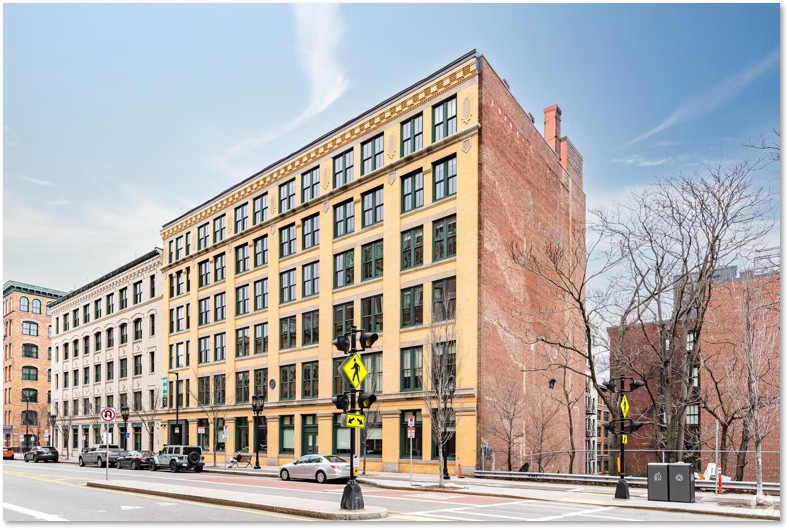
320 Summer Street; Courtesy of LoopNet
This low‑rise, commercial office structure was built in 1904 as part of the Boston Wharf Company’s neighborhood of warehouses and offices. It has primarily brick-and-beam construction, with original hardwood floors, open ceilings and large windows, reflecting a classic early 20th‑century office design.
The structure has been adapted over time for office use. Recent renovations have —preserved much of its historic character while upgrading amenities like ceilings, windows, and flooring. Fan Dun’s filing with the Boston Planning Department includes designs to build an interior mezzanine level for some loft-style units.
The Street’s History
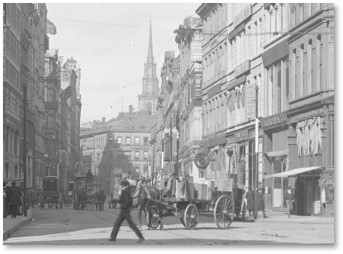
Summer Street
Summer Street is a long street with a long history that you can read about in my blog post on Winter and Summer Streets. Many famous people have lived on Summer Street. You could be one of them.
Imagine living and working in the Seaport without having to deal with its traffic. Imagine the proximity to lobsters and chowdah. It’s also less than a 10-minute walk to the city’s South Station transportation hub and the Seaport’s Silver Line T if you want to get around town.
Conversions: The Best Solution to Two Problems
While none of the recent buildings being renovated to residential units is historical or of notable architecture, I think that’s a good thing. The conversions mean the ordinary structures that contribute so much to Boston’s character won’t be demolished in favor of the current preference for new buildings with no character at all.
A city can only hold so many tall featureless apartment structures with unbroken glass curtain walls before it starts to look like a mass of quartz crystals grouped in blocks. Plus, who wants to live in a box with no architectural features, no interesting nooks and crannies, and limited flexibility for decoration?
The 29 buildings already scheduled for conversions or undergoing construction are built of brick, granite, and masonry with solid floors, high ceilings, big windows (that might actually open), and interesting shapes.
I find this program to be the best possible solution to Boston’s glut of commercial office space and dearth of residences. Turn one into the other and you still have a real city.