The Department of Defense, for the first time in almost 10 years, has dramatically reduced its number of recognized religious faiths and belief systems. The DoD slashed its official list from 211 to 31, dropping roughly 180 belief systems for the first time since 2017.
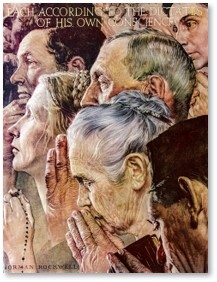
Freedom of Worship by Norman Rockwell
Several prominent faiths have lost their “recognized” status because they have been deemed insufficiently Christian. Here’s a list of some in alphabetical order:
- Atheism
- Asatru
- Deism
- Druidry
- Eckankar
- Heathens
- Humanism
- Magick (practitioners)
- New Age Churches
- Paganism
- Rosicrucianism
- Shamanism
- Spiritualism
- The Troth
- Unitarian/Universalism
- Wicca
Freedom of Religion
Some of these may be unfamiliar to you. Some may sound funny. You may think a few are not religions at all. You will find a short description of each here at msn.com.
But the authenticity of any religion, really, is not up to you or me or anyone outside of it. We still have freedom of religion in America, although I wonder whether that will survive this administration.
Why the List of Faiths Is Important
According to Raven Fon in msn.com:
“Recognition on the Pentagon’s faith list directly affects a service member’s ability to access chaplain services, request religious accommodations, and have their faith recorded in official military records.”
In addition, it…
“…determines whether a chaplain can be formally assigned to support them, whether their faith gets flagged for dietary or observance accommodations, and whether they’re seen, administratively, as someone with a recognized spiritual identity at all.”
For service members who fall in battle, it also determines what type of grave marker will be erected in a military cemetery.
My Unitarian/Universalist Congregation
 The secretary’s action angers me however, because one of the faiths struck from the lists is mine: Unitarian/Universalist. I attend a U/U church that separated from the Puritans in 1839. We worship in a church that was built in 1797, replacing an earlier and much smaller meetinghouse that was erected in 1723. The congregation itself was gathered in 1684.
The earlier church’s bell summoned the Minutemen from Sudbury, MA who fought at the battles of Concord Bridge and Lexington Green.
Unitarianism is a 500-year-old faith that merged with Universalism in 1961.
Unitarian Faiths Among the Founders
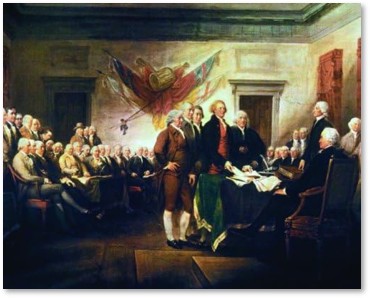 Unitarian Universalists and Deists are among two faiths represented among signers of the Declaration of Independence — although Unitarians and Universalists were separate groups at the time.
Key Unitarian Founders and U.S. Presidents were Unitarians. They include:
- John Adams – A prominent Unitarian minister and signer of the Declaration of Independence, Adams was a leading figure in the American Unitarian movement and a strong advocate for religious liberty.
- Thomas Jefferson – While Jefferson was a Presbyterian, he was a known Unitarian in private life, emphasizing reason and moral virtue while rejecting the Trinity and the divinity of Jesus.
- John Quincy Adams – The sixth U.S. president, he was a Unitarian minister and a vocal supporter of religious freedom.
- Millard Fillmore – The 13th president, he was a Unitarian minister and abolitionist.
- William Taft – The 27th president, he was a Unitarian minister and a strong advocate for civil liberties.
In other words, a faith that was good enough for Presidents of the United States and two signers of the Declaration of Independence is not good enough for the nation’s military.
Prominent Unitarian thinkers and writers of the 19th century were Henry David Thoreau and Ralph Waldo Emerson. Famous Unitarians range from Louisa May Alcott and Daniel Webster to Paul Newman and Ray Bradbury.
More Than Downsizing the List
To me, this is not the downsizing action Sec. Hegseth promoted in March when he noted that that 82% of members who identify as religious use only six of the codes.
At best, it demonstrates his contempt for any religion other than certain types of Christianity. At worst, it represents another step in Sec. Hegseth’s drive to make the United States military a Christian Nationalist organization. (To be accurate: a white, straight, male Christian organization.)
Why do I think that? Well, another religion initially struck from the list was Mormonism: the Church of Jesus Christ of Latter-Day Saints. (It has been returned to the approved list following Congressional protests.) How anyone could find a faith that has the name of Jesus embedded in its own name to be insufficiently Christian? Unless, of course, that’s not the real reason. Hmmm.
A Christian Congregation?
Is our congregation Christian? We are not, although some U/U congregations are because that is their choice. Unitarian/Universalism is not a “creedal” faith, which means we have no dogma that congregants have to believe. There is no Unitarian/Universalist version of the Apostle’s Creed, for example. We do not baptize.
Neither does a centralized structure tell us what to do, how to do it, or who should stand in the pulpit. We make our own rules for our congregation, hire our own ministers, and decide for ourselves how we choose to worship.
I can see where that kind of independence would make Sec. Hegseth nervous.
Are Catholics Next?
Although Roman Catholicism remains on the approved list of faiths, I think Catholics have reason to be nervous. In April of this year, Sec. Hegseth arranged a Protestant-only Good Friday service at the Pentagon’s Memorial Chapel, with no Catholic Mass scheduled for the first time. The service was explicitly framed as Protestant-only. Roughly a quarter of U.S. service members are Catholic, making the absence of a Catholic observance notable.
If the idea of a straight, white, male Christian army that answers to one man makes you nervous, welcome to my world. To me, it’s a step on the road to Gilead and not many of us want to go there.