It’s summer and Boston’s Seaport District has come alive. Tourists arrive, cruise ships dock, rooftop bars serve customers, lobsters boil, chowder cooks, Sammy Summuh gets poured, and everyone is happy. With so much to see and do, you might miss a piece of modern artwork by one of America’s foremost painters that’s hidden in plain sight.
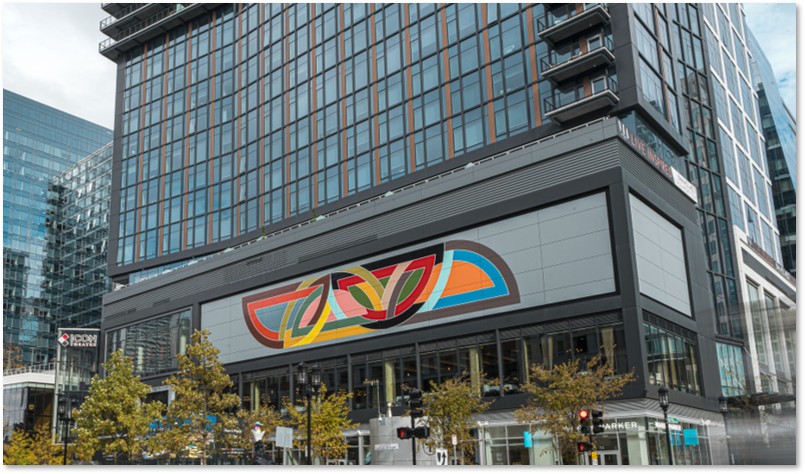
Damascus Gate (Stretch Variation 1) courtesy of justkids.art
“Damascus Gate (Stretch Variation 1)” by Frank Stella was installed at 60 Seaport Boulevard in 2019, just above the first floor. AT 98’×18’, the mural is a larger version of his 1970 painting of the same name. It is one of the largest public art installations of Frank Stella’s 60-year career.
The Protractor Series
“Damascus Gate (Stretch Variation 1)”is one of the late Mr. Stella’s “Protractor Series” paintings and one look will tell you why. (For those of us who remember what a protractor is.)
I couldn’t begin to describe this mural in the kind of language used in art circles and gallery catalogs, so I will quote ArtNet:
“The series marked an important transitional phase between his early flat works and his later three-dimensional creations. The monumentally scaled Damascus Gate (Stretch Variation I) also features many of the most iconic motifs from Stella’s oeuvre, including what he calls his “interlace,” “rainbow,” and “fan” shapes.”
Who Was Frank Stella?

Frank Stella, courtesy of Architectural Digest
Born as the oldest child of first-generation Italian parents in Malden, MA, Mr. Stella studied at Phillips Academy Andover and then Princeton University. As a young man, he would travel to Boston’s seaport when it was just a gritty commercial district to buy canvas from sailmakers.
He later made his way to New York City where he established himself in minimalism and “post-painterly abstraction” as a painter, sculptor and printmaker. While he spent most of his career in New York, Boston remained a significant part of his life and artistic identity.
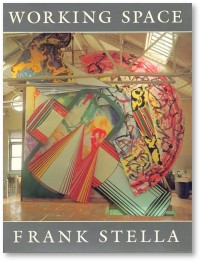
In the early 1980s, Mr. Stella returned to Massachusetts to deliver a series of lectures at Harvard University. These talks formed the basis of his book Working Space, which is considered one of the most important writings on modern art. The lectures both cemented his reputation as a leading figure in American art and tied him closely to Boston’s academic and cultural institutions.
Installing “Damascus Gate”
Commissioned by WS Development in partnership with Marianne Boesky Gallery, the installation of “Damascus Gate (Stretch Version 1)” marked Mr. Stella’s first major public art project in Boston. The work features bright and colorful intersecting shapes inspired by Islamic art. It has become a prominent landmark in the Seaport.
 This Boston project was both a personal and artistic homecoming. When in his eighties, Mr. Stella described the choice of the largest variation in the protractor series as “pretty straightforward” and noted that it fit the space well.
The mural is clearly visible above retail stores on Seaport Boulevard and is celebrated as a gift to the city.
Frank Stella died on May 4, 2024 at the age of 87.
More Art Hidden in Plain Sight
“Damascus Gate (Stretch Version 1)” joins other works by major artists that appear here and there in the city. You can find these free-range artworks easily without tickets or entry fees. They are visible both inside and outside, just not contained within the walls of one of Boston’s excellent museums.
I have written about some of Boston’s Art Hidden in Plain Sight before. Here are links to those posts.
- Sol LeWitt on Congress Street
- The Four N.C. Wyeth Banking Murals
- Faneuil Hall’s History Painting
- The Pru’s “Boston Tapestry” Sculpture
- Robert Motherwell’s JFK Mural
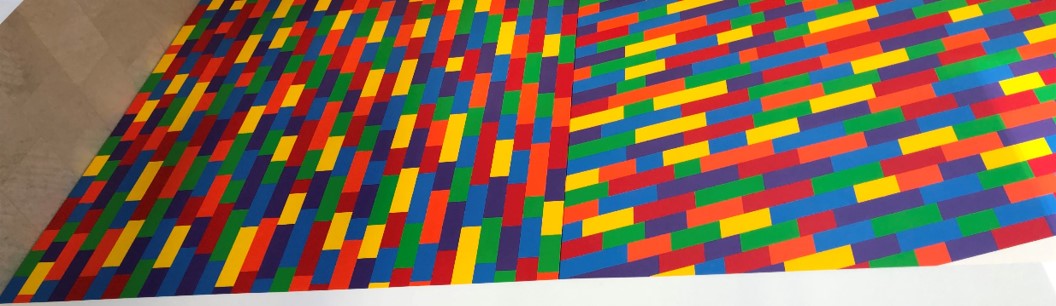
A portion of Drawing #1128 by Sol LeWitt