June 14 is Flag Day and I decided to celebrate it by noting some of the interesting American flags you can find around Boston. You will, of course, find flags on poles all over the city and in the usual places but I prefer to focus on flags you may not have seen.
No Flags on the Buildings

Youth’s Companion Building
In searching my photos, I found it interesting that flags were rarely included in decorations on buildings in Boston. Even in the 19th century, when buildings sported carvings and ornaments of all kinds, the flag was not a popular theme. Allegorical figures, gods and goddesses, cornucopia, maritime objects, and animals (especially lions and eagles) took center stage while patriotic images faded into the background.
It seems that, having fought so hard to create a new country, we then turned our artistic attention to other things. I did uncover flags in a few places, though, some of them unexpected. Here’s what I found.
The Youth’s Companion Building
One can’t be surprised at finding flags in this building. The Youth’s Companion Building is, after all, where the Pledge of Allegiance was written. You can read all about that in my blog post on the building and the history of the Pledge.
In honor of Flag Day, however, I offer the poster above with its flag in the lobby of the building. It’s one of four decorating the lobby and confirming its historic status. How better to start a Flag Day post than with the Pledge of Allegiance?
The Massachusetts State House Murals
The Massachusetts State House has many flags wherever you look. The building’s second floor shows them everywhere, predominantly in the murals on the second-floor walls by artist Richard Armstrong. He painted the American flag marching to battle with the troops going to different wars in different eras. Old Glory also serves as a backdrop for archetypal figures like Columbia and Freedom.
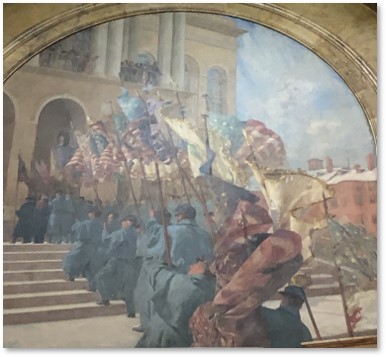
Return of the Colors to the Custody of the Commonwealth
I have favorites, though. One is entitled, “Return of the Colors to the Custody of the Commonwealth, Massachusetts State House” by Henry Oliver Walker and Edward E. Simmons. It depicts the regimental flags being returned from the Civil War to the State House in the ceremony known as the Trooping of the Colors.
This ceremony marks one of only three times the building’s Bulfinch Entrance is used. I love the movement and energy of the men and the regimental flags returning to the State House’s Hall of Flags.
The mural, which fills an archway, is much more colorful than it appears in this photo and recommend getting a first-hand view of it.
The Bloody Regimental Color
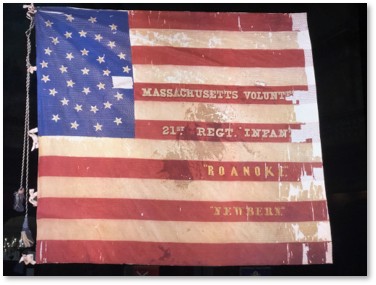
In the hall, you will find the Regimental Color of the 21st Massachusetts Volunteer Infantry from 1862 mounted in a case. The plaque beneath it says,
“The position of color bearer was undoubtedly one of the proudest as well as most dangerous a soldier could hold. The flags, always posted at the front, served as a beacon for one’s fellow soldiers and the enemy alike. To ‘preserve the Union’—to never let it fall to the ground—was the gravest of responsibilities… one for which many color bearers gave up their lives.
“During the Battle of Fredericksburg, Virginia, at least five men in turn bore this national color before being wounded. One, Sgt. Thomas Plunkett, upon receiving the flag, moved to the front rank where it is recorded: ‘A shell was thrown with fatal accuracy at the colors, which brought them to the ground wet with the lifeblood of the brave Plunkett, both of whose arms were carried away.’
“Amazingly, Plunkett grasped the flag with his upper arms to keep it from falling, pressing on before being relieved. The center of the flag also bears the blood of Sgt. Peter Bryan, who, positioned beside one of the color bearers, fell, mortally wounded in the head.”
Glory is one thing but the blood stains on the Regimental Color and the ragged edge of a flag blasted in half testify to the real human cost of war.
All Saints Way Flag
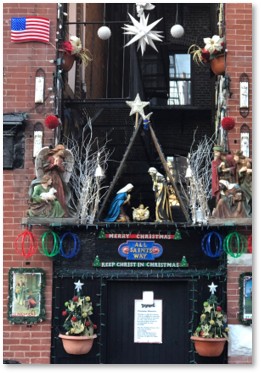 This private shrine in the North End changes with the seasons but often includes an American flag. It doesn’t matter if it seems incongruous flying above a nativity scene or other religious imagery.
Immigrants often do a much better job of honoring the flag of their adopted country than native-born citizens. Where we take it for granted, they demonstrate their gratitude for being in America and their pride at being part of a great country.
Want to know where you do find a lot of flags, shields, images of Columbia and Liberty? On carousels. The reason is simple: the horses and other animals were carved by immigrants.
The Charter House Restaurant Flags

Chart House Eagle
As I explained in my post about Long Wharf’s Historic Buildings, the Chart House restaurant occupies the Gardiner Building.
This is the oldest surviving building and the only remaining one of the colonial brick warehouses built on Long Wharf. It originally served as John Hancock’s counting house.
If you stop in for lunch or dinner (I recommend the chowdah), you will see a magnificent gilded eagle on the second floor flying about a shield and crossed American flags.
Sudbury Company of Minute and Militia
On a rainy Independence Day, the Sudbury Company of Minute and Militia marched, as they do in every the Fourth of July parade. The rain did not dampen the powder in their muskets, nor the music in their fifes. The American flag kept flying along the parade route, although it was wet.
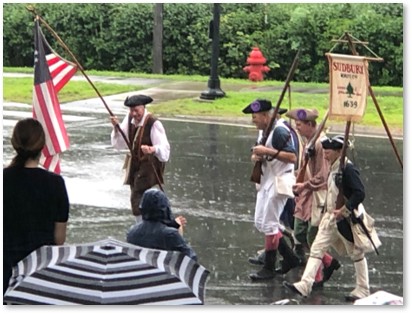
Long may she wave.