 All signs are pointing toward a Blue Wave in this year’s midterm elections. Many of us welcome that change but I fear that far too many Americans are taking it for granted. Why? Because we have trust in our elections and expect them to be honest. That used to be the case but no longer, thanks to voter suppression.
Beware complacency. Do you really think the Republicans are going to go down to defeat with grace and decency? Do you think Donald Trump and his minions will simply accept that they lost? If so, you are not paying attention.
Project 2025 Proposals for Voter Suppression in 2026
 Project 2025 gave us the Republican playbook in detail. That document actually tells us what they are going to do when it comes to making sure elections go their way. While Project 2025 does not literally use the phrase “suppress the vote,” multiple independent analyses give us the plan.
These conclusions come from civil‑rights groups and legal experts who have reviewed the voting‑rights sections of Project 2025 and predict the administration’s early actions.
Their analyses show that the document’s election‑related proposals would enable or accelerate voter suppression tactics in 2026. What follows is a clear, well-sourced breakdown of what Project 2025 proposes along with how those proposals are expected to affect the 2026 midterms.
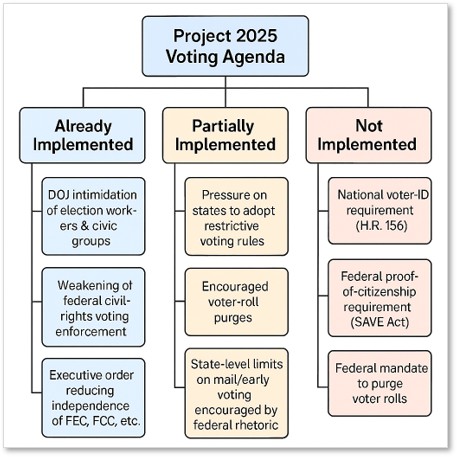
Here are the Big Six Republican tactics for voter suppression. Some are planned, while others have already been implemented, at least in part.
-
Criminalizing normal election work
The blueprint proposes shifting election‑related prosecutions away from the DOJ Civil Rights Division and toward a more punitive posture. It recommends using a century‑old civil‑rights law to investigate and prosecute election officials and voter‑registration workers who help people vote.
 Civil‑rights groups warn this would intimidate election workers and discourage voter‑registration efforts. It would also have a chilling effect on voter‑registration drives, especially in communities of color, students, and low‑income voters.
The Brennan Center for Justice reports that the administration is already using executive actions and public threats to stifle election‑protection work. These include public threats of prosecution as the DOJ’s posture shifts toward punitive investigations. The plan is to suppress voter registration activities and frighten election workers.
-
Purging voter rolls
Analyses of Project 2025 show Project 2025 encourages (1) Large‑scale voter‑roll purges, (2) Strict matching requirements, and (3) More aggressive “cleaning” of voter lists that disproportionately remove eligible voters.
This would result in higher rates of wrongful removal, especially for voters who move frequently, renters, and young voters. Some voter-roll purging happened in 2024.They people don’t know they’ve been purged until they show up to vote.
Project 2025 encourages large‑scale purges and strict matching rules. Despite a lack of nationwide implementation, civil‑rights groups report increased pressure on states to adopt these practices.
-
Restricting mail voting and early voting
Project 2025 frames expanded mail voting as a threat and encourages (1) Rolling back mail‑in voting, (2) Limiting ballot drop boxes, and (3) Reducing early‑voting options.
In the 2026 midterm elections this would reduce access for seniors, disabled voters, rural voters, and people who work multiple jobs.
While there have been no federal-level actions, government rhetoric has encouraged state‑level actions. Trump has said on Truth Social that he wants to “lead a movement” to ban voting machines and mail-in ballots in time for the midterm elections. He also expressed regret that he did not order the National Guard to seize voting machines after the 2020 election.
-
Applying federal pressure on states to adopt restrictive rules
The Brennan Center notes that the administration is already using executive actions and public threats to pressure states to adopt anti‑voter policies that are aligned with Project 2025.
Because of this, states may feel compelled to adopt stricter ID rules, reduce polling locations, or tighten registration deadlines. In fact, this part of Project 2025 is already underway. The House of Representatives has been considering — and in some cases passing — legislation that would mandate voter ID or proof of citizenship for federal elections.
- H.R. 156 offers the clearest example of a national voter‑ID mandate currently under House consideration. This bill, introduced in the House on January 3, 2025, explicitly aims to establish consistent photo‑identification requirements for voting in federal elections.
- The SAVE Act is a related but distinct effort focused on citizenship documentation. It requires documentary proof of U.S. citizenship to register to vote in federal elections — a stricter requirement than voter ID at the polls. The SAVE Act passed the House in 2025 but stalled in the Senate.
-
Weakening enforcement of the Voting Rights Act
Project 2025 proposes three approaches to weakening the Voting Rights Act. The first is defunding or restructuring the DOJ’s Civil Rights Division. Secondly, they plan to end federal oversight of discriminatory voting practices. Lastly, they will curtail enforcement of Section 2 of the Voting Rights Act. These actions would allow states to implement discriminatory rules with little to no federal pushback.
The Brennan Center notes that the administration has already taken steps to undermine federal election‑protection efforts through executive actions targeting agencies responsible for safeguarding elections.
They have implemented executive actions that reduce the independence of agencies involved in election oversight. In addition, they have moved to weaken federal civil‑rights enforcement in elections.
- Targeting civic‑engagement organizations
The Brennan Center reports that Project 2025 encourages the DOJ to investigate and prosecute organizations that help people vote, including voter‑registration groups. This would reduce turnout among first‑time voters, students, and marginalized communities. It would also have a chilling effect on voter‑registration and election‑worker activity.
The administration is right now using executive actions and public threats to warn off election‑protection workers. In addition to public threats of prosecution, the DOJ’s posture is shifting toward punitive investigations.
 The Bottom Line on Voter Suppression
Project 2025 lays out a framework for voter suppression that would make voting harder, increase intimidation of election workers, and weaken federal protections — all of which experts say would lower turnout in the 2026 midterms. Common sense tells us the same things.
The kicker is that they can suppress the vote without using any of the tactics planned in Project 2025. For a detailed discussion of more ordinary tactics, listen to the Politics Girl podcast of January 12, “Will we have elections in 2026?” As Marc Elias says, all they have to do is make voting really, really inconvenient.
Voter Suppression Through Inconvenience
They just need a like-minded state government willing to play along. Local police departments can close off streets to make access to polls impossible. In 2024 they closed polling places on university campuses and in districts that vote Democratic, so voters had to travel farther. In the same way, cities and towns can close garages and parking lots close to polling places. Polls can also close early, locking out off voters standing in line. Republicans actually did this in some Red states in 2024.
Pay attention. We have 10 months for the Republicans and the current regime to throw a monkey wrench into our voting processes. The party and its policies may be unpopular, but the Republicans are also powerful. They control all three branches of government. Even though the full blueprint is far from fully enacted, anti‑voter tactics are already in motion. The Roberts Six in the Supreme Court will do their best to keep them rolling ahead.
Complacency is the enemy
 We can’t afford to be complacent about the midterm elections. We have 10 months in which to fight their voter suppression efforts. Simple responses like busing voters to polling places and helping people to obtain approved IDs can go a long way toward deploying our own monkey wrench. We either make it happen or it won’t happen.
Plan for the worst and hope for the best. That has to be the motto of the resistance. We can’t afford complacency or feeling smug when they lose a special election. Maya Angelou once said, “When someone shows you who they are, believe them the first time.” When they show you what they plan to do — and even put it in writing — pay attention.
Getting out the vote and getting voters into the polls have to be our simple focus.