Copp’s Hill Terrace
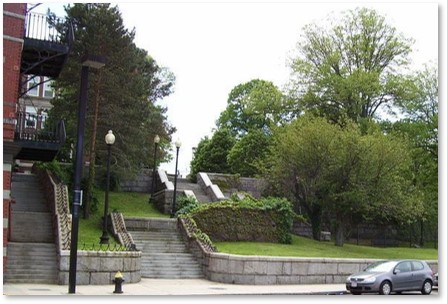
A massive granite promontory and park off Charter Street, Copp’s Hill Terrace has witnessed Boston’s history since it was built in the 1890s. Today it offers a wonderful panoramic view of Boston Harbor, Old Ironsides, and the Bunker Hill Monument.
Copp’s Hill is the highest point in Boston’s North End and the third-highest point in the city, after Beacon Hill and Roxbury’s Fort Hill. Crossed by the Freedom Trail, it holds its own roster of historical sites.
History of Copp’s Hill Terrace
By the late 19th century, much of the land in this area was owned by the Boston Gas Light Company. Tenement houses crowded the hillside. In the early 1890s John “Honey Fitz” Fitzgerald, then a city counselor and later Boston’s mayor, secured funding to develop a city park there. The park’s funding was authorized in 1893, with the final design completed by October 1894.The city took land by eminent domain from the Copp’s Hill Burying Ground down to the waterfront.
Langone Park, on the other side of Commercial Street, which includes the terrace, is the only public park designed for Boston by the noted landscape architect Charles Eliot. A partner in the famous firm of Olmsted, Olmsted and Eliot, he envisaged the master scheme for the Boston Metropolitan Park System (1892–1893) but designed this park personally. It is one of the few larger open spaces in the densely-built North End.
The area, including what was first called North End Park and is now Langone Park, was intended by designer Charles Eliot to provide both passive and active recreation opportunities. He conceived it as a “resting place” and a vital recreational space with waterfront views and breezes that would give local residents a respite from crowded streets and often unsanitary living conditions.
As Mr. Eliot wrote to his wife in 1895, Copp’s Hill Terrace provided a recreation retreat for,
“the slum people . . . unclean beings, children pushing everywhere and swarming in every street and alley” (Charles Eliot, Landscape Architect, 485–86)
Although his early designs were informal, city leaders pushed for the more formal design that was eventually implemented. The terrace consists of a landscaped arrangement of granite steps, knee-walls and banisters with cast-iron parapets. The final construction included grassy areas and trees, as well as conduits for electric lighting.
Commercial Street
Commercial Street itself was not created until after 1824 as part of the major land‑filling and waterfront redevelopment associated with the Quincy Market project begun in 1823.
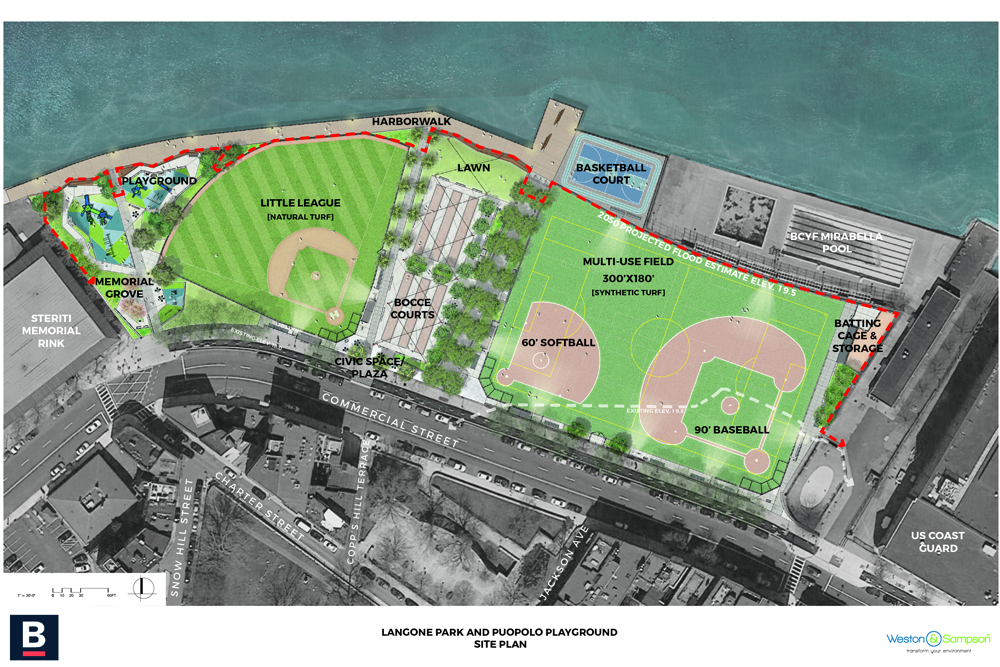
The area where Commercial Street now runs was originally tidal flats south of the old Shawmut Peninsula. The land was made by extensive filling operations in the 1820s–1840s, after which new streets—including Commercial Street—were laid out.
That means early views from the hilltop would not have included Commercial Street at all—just tidal mudflats and wharves.
A View Into History
Although the terrace didn’t exist until the nineteenth century, the site has seen its share of American history.
- Had the terrace existed in 1696, a Bostonian would have looked toward 379 Commercial Street to see workmen building the North Battery to defend the city.
- Had the terrace existed in 1704, curious crowds could have stood there to watch the hanging of the Pirate John Quelch and several of his crewmen on Copp’s Hill Flats.
- Had the terrace existed after 1792, a visitor would have been able to look down to the intersection of Foster and Commercial Streets to see the foundry where Paul Revere cast church bells.
- Had the terrace existed in 1794, one would have seen Constitution Wharf at 409 Commercial Street where shipwright Edmund Hartt was laying the keel for the USS Constitution.
- Copp’s Hill Terrace had its greatest moment in 1919, when it served as the platform for crowds of Bostonians to watch the aftermath of the Great Molasses Flood. As author Stephen Puleo says in his excellent book Dark Tide, “A crowd had gathered on the rise of Copp’s Hill Terrace and looked down silently at the destruction.”
Copp’s Hill Terrace for Tourists
I often use Copp’s Hill Terrace as a stage for narration during a tour of the North End for cruise-ship passengers. It offers bench seating, shade from leafy trees, and breezes off the harbor. My tour groups can relax in comfort while I talk about Old Ironsides, the Battle of Bunker Hill, and the Monument.

But their favorite part is the North End story of the Great Molasses Flood. It entrances them because it’s so unusual and unexpected. Some British tourists ask what molasses is, and I tell them it’s treacle. Others ask for more details or whether there’s a book they can read. (Dark Tide by Stephen Puleo) I think they show some of their appreciation in their tips, although there’s no way to measure that.
Copp’s Hill Terrace was added to the National Register of Historic Places in 1990.