In a typical Wall Street Journal op-ed article, former Republican Strategist Karl Rove warns “Don’t Bank on a Texas Blue Wave.” Well, I agree with him on that. Democrats shouldn’t bank on anything. They should be leery of letting the current poll results make them complacent or taking victory anywhere for granted.
 But I do think Mr. Rove is wrong on this one. Why? Because he’s looking back at previous Texas elections and their results. He uses poll numbers and voting patterns to make his point. Fair enough, if this year was like any other year. But it is not.
Yes, in any state fewer people vote in primaries than they do in regular elections. But more Republicans vote in elections where Trump is on the ballot, and he is not running for office in November’s midterm elections. Also, his policies are so unpopular, Democratic candidates have flipped 28 seats in special elections across the country since Trump won in 2024. That’s a Blue Wave building in advance of the midterms.
Population Trends and the Blue Wave
I really dispute his conclusions, however, in his blindness to population trends in Texas. The news frequently carries stories of companies moving to Texas from blue states like California for a variety of reasons. I wondered just how many adults of voting age had moved with their jobs and their companies to Texas in the past few years.
It seems unlikely to me that Democrats, liberals and progressives would change their political leanings the minute they cross the state line. How many people of voting age have relocated into Texas from blue states for their jobs. I have wondered just how that would affect Texas politics. But I couldn’t put a number to that migration or its impact.
So, I asked my office assistant to calculate the number of adults for me. Co-pilot works faster than I can and is better at math, so I had high hopes. Turns out, this effort was difficult even for AI. Co-pilot did provide me with some information, though, and I offer it for your consideration.
A Strong Picture
We can piece together what the data show — and they paint a picture of a strong direction. I asked how many people of voting age have relocated into Texas from blue states for their jobs
Given that the U.S. Census, Texas Demographic Center, and major migration studies do not break migration flows down simultaneously by origin state partisanship. plus age eligibility, plus job‑related motivation, we don’t have specific numbers. Current data can tell us a few things, though:
Inbound Net Migration
First, there has been and continues to be a large net migration from blue to red states — including Texas. A 2024 CEPR analysis found that since 2020, cross‑state movers have primarily relocated from blue states to red states, driven heavily by job mobility and remote‑work opportunities. Texas is receiving substantial inflows from blue states.
Driving Texas Population Growth
Second, domestic migration drives Texas population growth. The Texas Demographic Center reports that domestic in‑migration, including from high‑cost coastal states, has significantly boosted Texas’ population growth from 2021–2024.
Work-Related Migration
Third, remote‑work and job mobility are major drivers of this in-migration. The CEPR study notes three reasons.
- State‑to‑state movers are 45% more likely to work remotely.
- Remote jobs are disproportionately located in left‑leaning (blue) states.
- Many of these workers are relocating to red states like Texas.
This strongly implies that a large share of blue‑state‑to‑Texas movers are working‑age adults, and many are moving because of job flexibility or job relocation.
Next, I narrowed the research dates to make them as relevant as possible. My Co-pilot office assistant did the math from 2020 to 2024 and concluded that:
Approximately 300,000 voting‑age adults moved from blue states to Texas
for job‑related reasons** from 2020 to 2024. The range is 200,000 – 450,000 over the five‑year period.
Migration Volumes
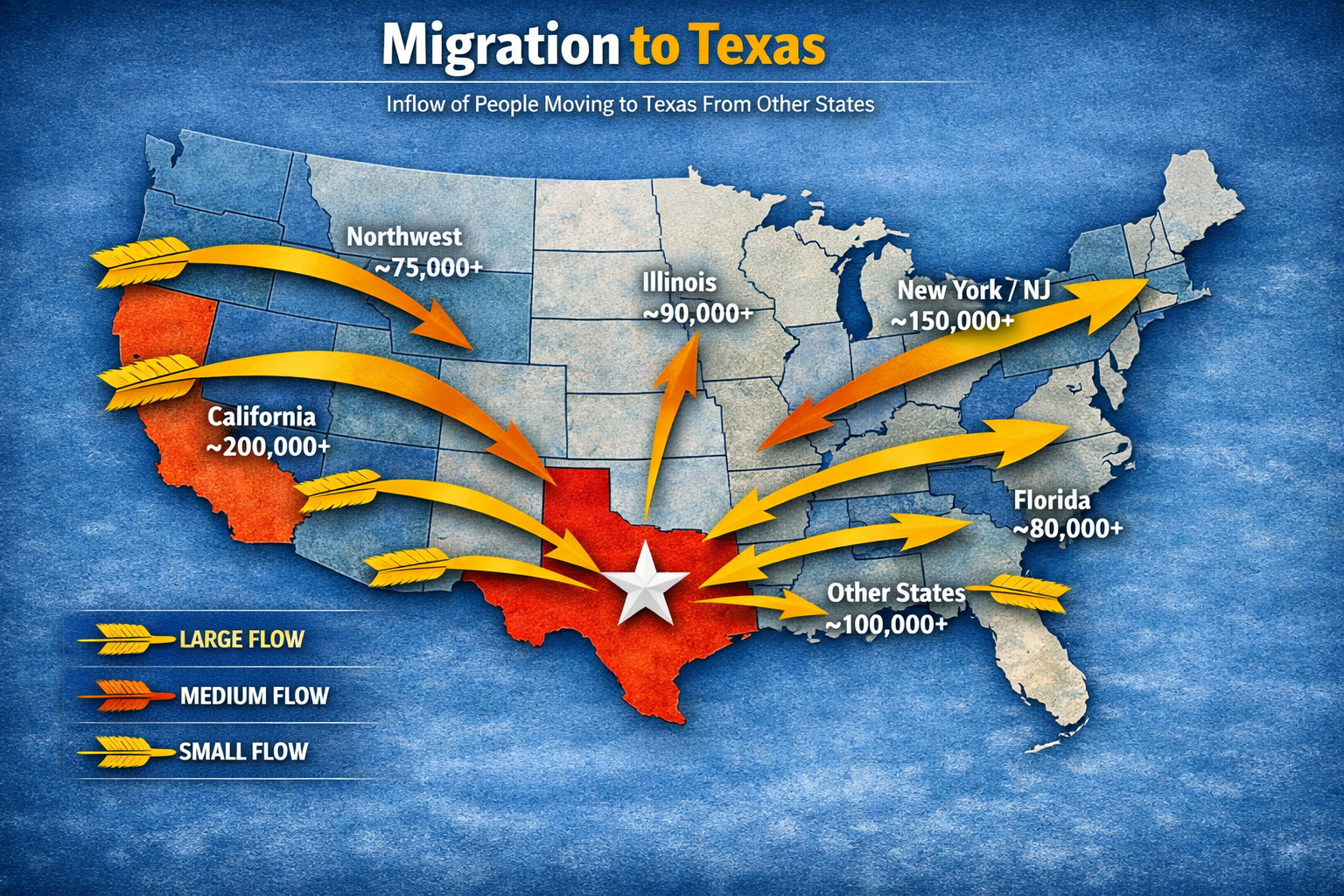
AI just couldn’t get the hang of those arrows. But you get the picture.
Estimated migration volumes (2020–2024):
• California → Texas: ~200,000+
• New York / New Jersey → Texas: ~150,000+
• Illinois → Texas: ~90,000+
• Florida → Texas: ~80,000+
• Northwest (WA, OR) → Texas: ~75,000+
• Other states combined: ~100,000+
Texas Registered Voters
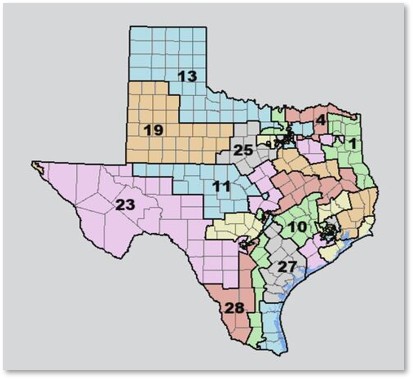
Texas voting districts 2022
As of March 2026, Texas has approximately 18.7 million registered voters. This figure was confirmed by the Texas Secretary of State ahead of the March 3 primary election. Voter registration has steadily increased alongside population growth. Texas has a relatively young population, so the actual registration rate among eligible adults is probably close to 75–80%.
When clustered in specific cities and counties, 300,000 new voters can make a difference. Texas is a big state but land doesn’t vote and nether do cows or oil derricks. Cities matter.
Differences of Opinion and the Blue Wave
 I cannot imagine why any woman of child-bearing age would want to move to a state where she has fewer rights than an assault rifle. But keeping your job or improving your employment status can weigh heavily on a decision like that, especially in an economy where jobs are increasingly difficult to get and to hold.
Now imagine that some of the adults of voting age who are moving to Texas from blue states don’t agree with many of the Republican policies and their results. They want a state that’s more affordable and has lower taxes. Again, fair enough. But other things go along with those advantages in a red state like Texas.
- Suppose women of child-bearing age decide they don’t like having the state make decisions about their health, their bodies, their pregnancies and even whether they will live or die. Women are pretty angry right now. Think about how that could sway electoral results in that state.
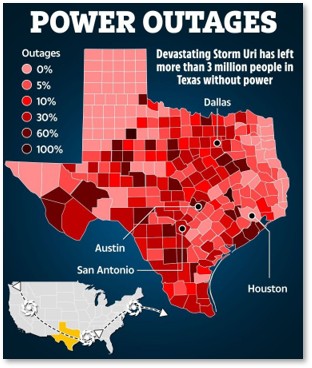
- Imagine that some of these new residents come from states where the electrical grid doesn’t go down in an ice storm, leaving them without power or heat. They might want to change the policies that created this disaster.
- Some new residents might not see any appeal in seating into the United States Senate a man known for his legal controversies, ethical concerns, and alignment with far-right priorities that critics argue undermine democratic norms and public trust.
Those are just three examples of issues that could drive new residents of Texas to vote for a Blue Wave. You won’t find them in the past, in statistics from previous elections, or registration patterns.
Is the Blue Wave Building in Texas?
That’s what Mr. Rove misses and why I disagree with him. I expect the November midterm elections to be very different from previous ones in Texas as in other states around the country.
Will there be a Blue Wave? I can’t say for sure although I certainly hope so. But Mr. Rove, looking backward as Republicans are wont to do, won’t see it coming.